Coastal Roofing in Clearwater: Materials That Withstand Sun, Salt, and Storms
August 21, 2025
Your Clearwater Roofing Guide: Protecting Your Home in Coastal Florida
October 20, 2025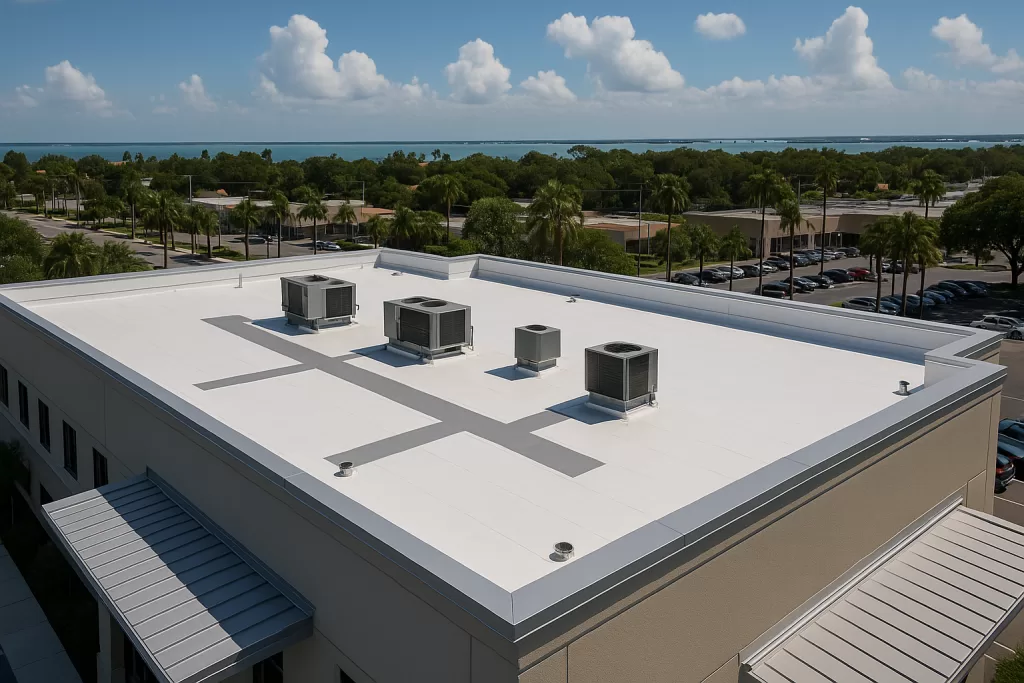
If you operate a business in Clearwater or across Pinellas County, your roof works overtime. It bakes under near-year-round UV, takes daily salt-air exposure off Clearwater Beach and Sand Key, and faces late-summer downpours that test every seam and scupper. September sits squarely in the heart of hurricane season, which means your commercial roof isn’t just a line item—it’s a risk control strategy. As a local commercial roofing contractor, I see the same pattern each year: minor issues discovered in spring become expensive leaks by fall; older membranes give up at the seams under ponding water; coatings chalk; fasteners back out along parapets; and rooftop equipment curbs become the weak link when winds sway. My goal in this playbook is simple: give Clearwater business owners a practical, code-aware roadmap to choose the right commercial roofing system, maintain it for the Gulf climate, and secure a warranty that actually performs when you need it most.
Whether you manage a hotel steps from Pier 60, a medical office near Morton Plant Hospital, or an industrial bay along the Belcher Road corridor, you’ll find specific guidance on materials (TPO, PVC, modified bitumen, metal), local permitting and product approvals, energy-saving options, and hurricane-readiness checklists you can implement this month. We’ll also demystify how Florida Building Code updates affect re-roof projects and why your job specs should call out wind uplift testing, edge metal standards, and securement at equipment curbs. And because we’re in Clearwater, we’ll talk salt spray corrosion, white roofs that cut heat load, and how to plan maintenance around afternoon storms.
Section 1: The Clearwater Climate Reality—What Your Roof Has to Survive
Commercial roofs here are asked to handle a unique combo: high UV, high humidity, salt-laden breeze, afternoon convective downpours, and episodic tropical-storm winds. On low-slope roofs, it means reflective membranes that resist heat and UV, adhesives and welds that can take thermal movement, and drainage designed for intense bursts of rain. On steep-slope metal roofs atop retail or church buildings inland near Coachman Park, coastal corrosion is the silent killer—selecting the right substrate and coating system matters.
Hurricane season officially runs June 1 through November 30, and NOAA’s 2025 outlook again telegraphed elevated risk across the basin. Practically that means Clearwater owners should verify wind-uplift compliance and securement details now—mechanical fasteners, perimeter and corner enhancements, and roof-mounted equipment bracing—before the next named system wanders into the Gulf.
Section 2: Code & Compliance—What Changed and What Your Spec Must Say
Florida updates its Building Code on a three-year cycle. The 8th Edition (2023) Florida Building Code took effect December 31, 2023, and it governs commercial roofing in Pinellas County today. If you last re-roofed under the 7th Edition, expect plan reviewers and inspectors to apply the newer wind design references, enhanced edge securement expectations, and updated product approvals on your 2025 project.
For facilities managers, here’s what that means in practice:
• Product Approvals and NOAs: Your spec should call for assemblies with Florida Product Approval or Miami-Dade NOA that match your building’s exposure and deck type.
• Wind Uplift: Clearwater sits in a high-wind region; your design professional will reference ASCE 7-16/7-22 hazard tools to determine the “ultimate design wind speed” (Vult) and pressure zones (Field, Perimeter, Corner). The edge and corner zones demand extra fastening density and heavier-duty edge metal.
• Edge Metal Standards: Ask your contractor to install edge systems tested to ANSI/SPRI ES-1 when required by code and the design.
• Permitting: Pinellas County uses an online Access Portal for permit applications, plan uploads, and inspection scheduling; make sure your contractor handles digital sealed drawings and calls out roof slope/drainage improvements.
Section 3: Choosing the Right Commercial Roof System for Clearwater
There’s no single “best” roof—it’s about fit for use, environment, budget, and maintenance appetite. Here’s how I help Clearwater owners decide.
TPO (Thermoplastic Polyolefin)
What it is: A white, heat-welded single-ply membrane widely used on retail centers and light industrial.
Why Clearwater likes it: High reflectivity cuts roof surface temperatures, helping lower cooling loads; seams are heat-welded; material is widely available with competitive warranties.
Owner notes: Specify thickness (60- or 80-mil for coastal durability), enhanced fastening at perimeters/corners, and reinforced walk pads along service paths to HVAC units. Avoid cheap, thin flashing stock at penetrations—go with reinforced. Require manufacturer-approved plates and fasteners for the deck type.
Where it shines: Big-box retail, distribution bays, schools.
PVC (Polyvinyl Chloride)
What it is: A heat-welded single-ply with excellent chemical and grease resistance.
Why Clearwater likes it: Restaurants and hospitals with kitchen exhaust benefit from PVC’s chemical resilience; it performs well in ponding areas when paired with proper design.
Owner notes: In coastal zones, we prefer KEE-modified PVC blends for plasticizer stability over time. Specify 60- or 80-mil. Use pre-molded corners and pipe boots to eliminate field-fabrication errors.
Where it shines: Hospitality, healthcare, coastal mid-rise with complex penetrations.
Modified Bitumen (SBS/APP)
What it is: Layered asphalt sheets, torch-applied, cold-applied, or self-adhered.
Why Clearwater likes it: Tough, redundant system with strong puncture resistance—great where foot traffic and rooftop equipment are heavy.
Owner notes: On concrete decks common in mid-rise buildings near the beaches, we like two-ply SBS with a granulated cap. Specify cool-color cap sheets to reduce heat. Use metal-clad base flashings at parapets.
Coatings (Acrylic, Silicone, Hybrid)
What it is: Fluid-applied systems extending life of sound roofs.
Why Clearwater likes it: Cost-effective life-extension when the membrane is mostly intact; silicone excels in ponding; acrylics offer high reflectivity and good dirt pickup resistance when formulated right.
Owner notes: Always demand adhesion and pull-test data on your specific roof. Coatings don’t fix saturated insulation—get infrared scans to verify dry substrate before coating. Require a detailed prep scope: cleaning, fastener re-seating, seam reinforcement, and primer where required.
Standing-Seam Metal (Aluminum or Steel)
What it is: Architectural or structural panels on steeper slopes—churches, retail facades, industrial offices.
Why Clearwater likes it: Long life, hurricane-ready clip systems, excellent water-shedding; aluminum resists coastal corrosion.
Owner notes: For buildings within a few miles of the Gulf, specify aluminum or Galvalume with high-performance PVDF coatings (Kynar 500®). Design to ASCE wind loads with clip spacing adjusted for corners and ridges. Specify sealed closures at ridge/hips and robust underlayment.
Section 4: Energy and Comfort—Cool Roofs That Actually Pay Off
White single-ply membranes and cool-color modified/metal roofs can reduce rooftop temperatures dramatically, especially during Clearwater’s long cooling season. Federal guidance recognizes cool roof products under the ENERGY STAR umbrella for efficiency—procurement language encourages reflective, tested products, which is a good proxy for commercial specifiers in the private sector as well. For your spec, call out minimum solar reflectance and thermal emittance targets and require third-party testing.
In mixed-use centers along Gulf-to-Bay Boulevard, we often pair a reflective membrane with increased polyiso insulation (R-values per code and owner goals) and thoughtful rooftop shading of equipment where feasible. The combination frequently lowers peak demand charges and keeps top-floor tenants happier—an underrated leasing advantage in competitive office markets.
Section 5: Hurricane-Ready Details—Small Choices, Big Differences
A roof fails at its edges, corners, and penetrations long before the field gives up. That’s why my Clearwater hurricane checklist is obsessively specific:
• Edge Metal: Use ES-1-tested systems with continuous cleats and correct fastener spacing; sealant-only “face metal” won’t cut it in a Gulf blow.
• Perimeter/Corner Fastening: Increase density per the wind zone tables; many failures start with flutter at the edge that travels inward.
• Parapet Caps: Hemmed, mechanically fastened, with splice plates and end dams—no short laps.
• HVAC and Curb Bracing: Tighten and replace loose fasteners; add curb braces; flash with reinforced membrane sleeves; re-seal counterflashing reglets.
• Drains and Overflows: Clear scuppers; verify bowl strainers are secure; confirm overflow scuppers are free.
• Lightning Protection: Re-attach loose air terminals; re-seal bases.
• Walk Pads: Install around service paths so techs don’t grind granules or puncture membrane during maintenance.
• Documentation: Photograph pre-storm conditions; log serial numbers and warranty contact info for quick claims.
The punchline: A 2-hour tune-up at the perimeter today is worth more than a new membrane that’s poorly secured tomorrow.
Section 6: Safety, Scheduling, and Your Operating Hours
Roof projects are construction sites above your customers’ heads. Your contractor must follow OSHA fall-protection requirements—guardrails, nets, or personal fall arrest systems—especially around roof edges, hatches, and skylights. Ask how they barricade ground-level pedestrian areas, schedule crane picks before store opening, and stage materials away from intake vents. OSHA’s rules are clear on the duty to provide fall protection during construction; ensure the plan is written, site-specific, and enforced.
For Clearwater’s weather, we stage tear-offs around radar windows and mobilize early to dry-in before the 3pm cloudburst. During September, we prefer partial-area tear-offs with immediate temporary dry-in and end-of-day integrity checks. If your roof serves a medical facility or data center, we’ll design phasing so critical units remain operational and rooftop pathways stay accessible.
Section 7: Warranties that Work (And What Voids Them)
Manufacturer warranties from names you know—GAF, Owens Corning, IKO (and for single-ply, brands like Carlisle, GAF, Johns Manville)—are only as good as the details in your spec and how the installer executes. For Clearwater coastal jobs:
• Require a manufacturer’s final inspection and a no-dollar-limit warranty if eligible.
• Make sure salt-spray and UV exposure are acknowledged in material selection (e.g., aluminum accessories on the coast, KEE-PVC for chemical stability).
• Specify periodic maintenance inspections (spring and fall) and keep logs; clogged drains, tenant damage, and unauthorized penetrations are common warranty issues.
• Understand exclusions: rooftop kitchen exhaust without proper grease protection, non-compatible sealants, unreported damage after a storm.
Section 8: True Lifecycle Cost—Budgeting for Replacement vs. Coating vs. Re-Cover
When is a coating right? When the existing roof is dry (verified by infrared), seams are largely intact, and the deck and insulation are sound. Coatings can provide 10–20 additional years at lower upfront cost than full replacement and minimal business disruption. Re-covers (adding a new membrane over an existing one) can be cost-effective if code allows and structure supports the added load—but Clearwater’s moisture loads and past leak history often push us to full tear-off for long-term reliability.
For 2025 budgeting, we give Clearwater owners a three-tiered plan:
• Tier 1—Preventive: semiannual maintenance; drain cleanouts; fastener re-seating; seams and flashings reinforced; minor coating touch-ups.
• Tier 2—Life Extension: strategic repairs; partial membrane replacement in high-traffic zones; full acrylic or silicone coating system with warranty.
• Tier 3—Replacement: new TPO/PVC/modified or metal system with upgraded insulation, ES-1 edge metal, and hurricane-ready perimeters.
Section 9: Real-World Clearwater Case Snapshots
Hotel near Clearwater Beach: PVC with KEE-modifier at kitchen exhaust zones, 80-mil thickness, enhanced corner fastening, ES-1 edge, and silicone-coated mechanical well. Results: improved grease resistance, lower rooftop temps, and a smoother manufacturer inspection for the 20-year warranty.
Medical office by U.S. 19: TPO re-cover over a dry BUR with tapered insulation to eliminate ponding near two internal drains; added walk pads to create a defined service path for HVAC techs; perimeter re-detail with new edge metal. Outcome: eliminated chronic leaks above a procedure room and reduced foot-traffic damage.
Industrial bay off Belcher Road: Aluminum standing-seam retrofit over structural sub-framing to minimize tenant disruption; PVDF finish; curb braces added; lightning protection re-attached; owner upgraded to cool-color panels. Outcome: durable, low-maintenance roof with excellent wind resistance and bright interior from added skylight panels (with curb cricketing).
Section 10: Maintenance Calendar for Clearwater Facilities Managers
January–March: Post-holiday inspection; check for cold-front wind damage; clear winter debris; plan spring projects before rainy season ramps up.
April–June: Pre-storm season maintenance; drain/scupper cleaning; seam checks; perimeter fastener audit; re-seal counterflashings; schedule infrared scan.
July–September: Afternoon storms and peak heat; schedule only urgent repairs and controlled partial tear-offs; confirm storm kit on site (tarps, sealants, fasteners).
October–December: Post-season assessment; warranty inspection; finalize 2026 budgets; book spring maintenance.
Section 11: Spec Checklist—What to Put in Writing
• Roofing System: TPO/PVC/Modified/Metal; thickness or gauge; color/reflectance; insulation R and taper plan.
• Wind Design: ASCE wind speed, exposure category, zone fastening patterns; ES-1 edge designation.
• Product Approvals: Florida Product Approval or Miami-Dade NOA references; accessories to match.
• Energy: Cool roof criteria—reflectance/emittance, third-party listing or test reference.
• Details: Flashings at parapets, walls, penetrations, and curbs; pre-molded corners; walk pads; expansion joints.
• QA/QC: Manufacturer technical rep involvement; daily photo logs; moisture scans for re-covers/coatings.
• Safety: Site-specific fall-protection plan aligned to OSHA 1926 Subpart M; barricades and schedules for crane picks.
• Permitting & Close-Out: Pinellas Access Portal submittals; inspections; as-builts; warranty documents.
Section 12: How Strategic Roofing Executes in Clearwater
On every commercial project, our team follows a repeatable, Gulf-coast-proven process:
- Assessment and Moisture Mapping
We inspect the field, edges, and penetrations; pull core samples where approved; and run infrared scans to identify wet insulation. This dictates whether a coating or re-cover is even on the table. - Design and Submittals
We coordinate with your design professional on wind loads, uplift testing, and tapered insulation layouts; submit digital sealed drawings for Pinellas review; and pre-order ES-1 edge metal and accessories to avoid field substitutions. - Phasing Around Your Operations
From beach-side hotels to medical buildings, we phase work areas to protect ingress/egress, time crane picks off-hours, and maintain rooftop access for critical service vendors. - Installation Quality
We assign an in-house foreman (not just a subcontractor lead), weld test coupons daily on single-ply projects, and photograph all hidden conditions (fastener patterns, insulation staggering) for your records and the manufacturer’s inspector. - Final Verification and Care Plan
We coordinate the manufacturer’s inspection, correct any punch items, and hand you a two-season care plan—spring and fall visits—with clear owner responsibilities to keep that warranty bulletproof.
FAQs
Q1: What’s the best commercial roofing system for coastal Clearwater?
There isn’t a single best system—it depends on building use, slope, and exposure. TPO is a great default for many low-slope buildings due to reflectivity and value; PVC excels near kitchen exhaust or where chemicals are present; modified bitumen offers toughness where traffic is heavy; and aluminum standing-seam thrives in coastal air thanks to corrosion resistance. A site-specific assessment should drive the decision.
Q2: How do I know if I can coat my existing roof instead of replacing it?
Start with an infrared moisture scan and targeted cores. If the membrane is mostly intact and the insulation is dry, a coating can add 10–20 years with less disruption. If you have saturated areas, blistering, or systemic seam failure, coatings are a temporary band-aid at best—budget for replacement or strategic tear-offs first.
Q3: What changed with the Florida Building Code that affects my 2025 re-roof?
The 8th Edition (2023) took effect at the end of 2023. Expect current wind design references, edge securement expectations, and product approval documentation to be strictly enforced on your permit and inspections. Your spec should address ES-1 edge, wind zone fastening, and correct product approvals for Pinellas.
Q4: Will a cool roof really lower my operating costs?
Reflective roof systems reduce roof surface temperatures and can cut cooling loads in Clearwater’s climate. Specify tested cool roof products and adequate insulation—together they deliver measurable comfort and energy benefits for tenants and staff.
Q5: How do you schedule roofing work during afternoon storms?
We break work into manageable zones, dry-in the same day, and end each shift with a perimeter and drain check. We also monitor weather continuously and stage materials for rapid protection if a cell pops up.
Q6: What about safety over my entrances and sidewalks?
Your contractor should implement an OSHA-compliant fall-protection plan, plus ground-level barricades, signage, and debris management. Ask to see the written plan before mobilization. OSHA
Q7: How long will a new commercial roof last in Clearwater?
With the right system and maintenance, single-ply roofs commonly deliver 20–30 years; modified bitumen and standing-seam metal can exceed that. Salt air and UV shorten life if materials and accessories aren’t specified for coastal exposure—another reason to select aluminum components and premium coatings near the beach.
Conclusion: Your Clearwater Roof, Strategically Done
A strong commercial roof in Clearwater isn’t luck—it’s the product of local design choices, code-aware details, and disciplined maintenance. When you specify wind-rated assemblies, ES-1 edge metal, reflective membranes, and coastal-appropriate accessories, you’re not just buying a roof—you’re buying business continuity for the next storm cycle. At Strategic Roofing, we take that responsibility personally. Let’s inspect your roof before the next Gulf squall does it for you. We’ll document what we find, prioritize the most cost-effective fixes, and give you a clear, line-item plan—whether that’s proactive maintenance, a targeted coating, or a full system replacement.
About the Author
We’re Strategic Roofing here in Clearwater. Our team and has installed and maintained commercial roofs across Pinellas County—from downtown Clearwater and Coachman Park to industrial facilities along Belcher Road and service businesses near Gulf-to-Bay. We’re certified with leading manufacturers, including GAF, Owens Corning, and IKO, and we stand behind our work with clear communication, meticulous documentation, and warranties that mean something when Florida weather shows up.